
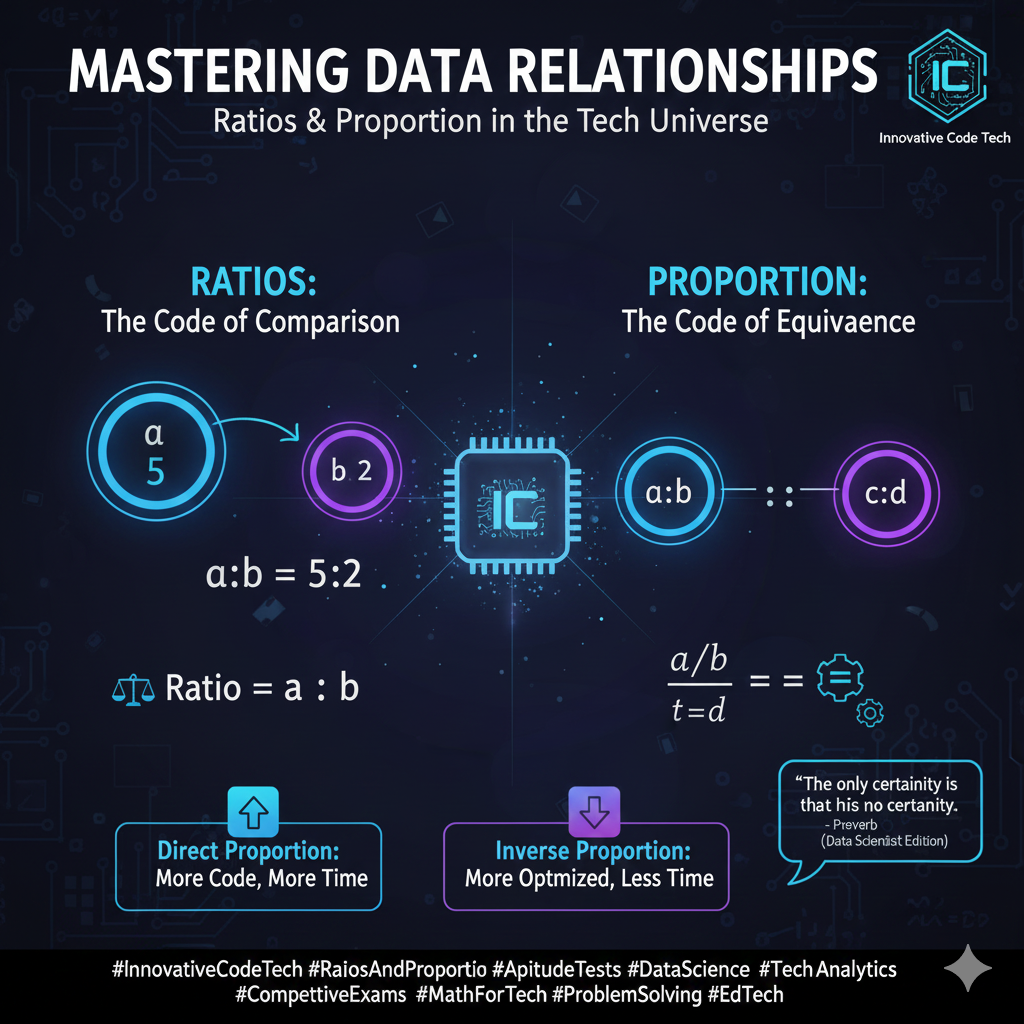
Ratio and Proportion made clear.
A ratio describes relative size, not the actual total. Convert each ratio part into a value only after identifying what the total or difference represents.
Key concepts in Ratio and Proportion
Ratio
a:b means a/b for the comparison of like quantities. Convert units before forming it.
Proportion
a:b = c:d implies ad = bc when the denominators are nonzero.
Sharing a total
For a:b and total T, shares are aT/(a+b) and bT/(a+b).
Direct and inverse variation
At constant price, cost rises directly with quantity. For fixed work and equal workers, time varies inversely with worker count.
Share ₹600 in the ratio 2:3
| Share | Parts | Money |
|---|---|---|
| First | 2 | ₹240 |
| Second | 3 | ₹360 |
| Whole | 5 | ₹600 |
A reliable solving method
- Write exactly which quantities the ratio compares.
- Simplify only after converting to common units.
- Use total parts for a total; use difference of parts for a difference.
- Check the calculated amounts reproduce the original ratio.
Step-by-step solved examples
Divide ₹600 in the ratio 2:3.
- Total parts = 2+3 = 5.
- One part = 600/5 = ₹120.
- Shares = ₹240 and ₹360.
A:B = 2:3 and B:C = 4:5. Find A:B:C.
- Make B equal using LCM(3,4) = 12.
- A:B becomes 8:12; B:C becomes 12:15.
- Combined ratio = 8:12:15.
Two numbers are in ratio 5:3 and differ by 18.
- The difference represents 5−3 = 2 parts.
- One part = 18/2 = 9.
- Numbers are 45 and 27; their difference is 18.
Ratio and Proportion: practice questions
Choose one answer before opening the explanation. Write down your reasoning as well as the option; a correct guess is different from a method you can repeat.
Simplify 18:24.
Show answer and explanation — question 1
Answer B: 3:4
Divide both terms by 6 to get 3:4; 6:8 is not in simplest form.
₹400 shared 3:5: smaller share?
Show answer and explanation — question 2
Answer B: ₹150
3/8 of ₹400 = ₹150.
2:3 = x:12. Find x.
Show answer and explanation — question 3
Answer B: 8
3x = 24, so x = 8.
Ratio of 1 metre to 50 centimetres?
Show answer and explanation — question 4
Answer C: 2:1
1 metre = 100 cm; 100:50 = 2:1.
A:B = 3:4, B:C = 2:5. A:C?
Show answer and explanation — question 5
Answer A: 3:10
Make B four: B:C = 4:10, giving A:C = 3:10.
Four equal workers take 12 days. Eight take?
Show answer and explanation — question 6
Answer B: 6 days
For fixed work, doubling equal workers halves the time.
Frequently asked questions
Can ratios contain decimals?
Yes. Multiply both terms by a common factor to remove decimals before simplifying.
When should I cross-multiply?
When two valid ratios are stated to be equal; first confirm they compare the same kinds of quantities.
Write exactly which quantities the ratio compares. Check the calculated amounts reproduce the original ratio.