
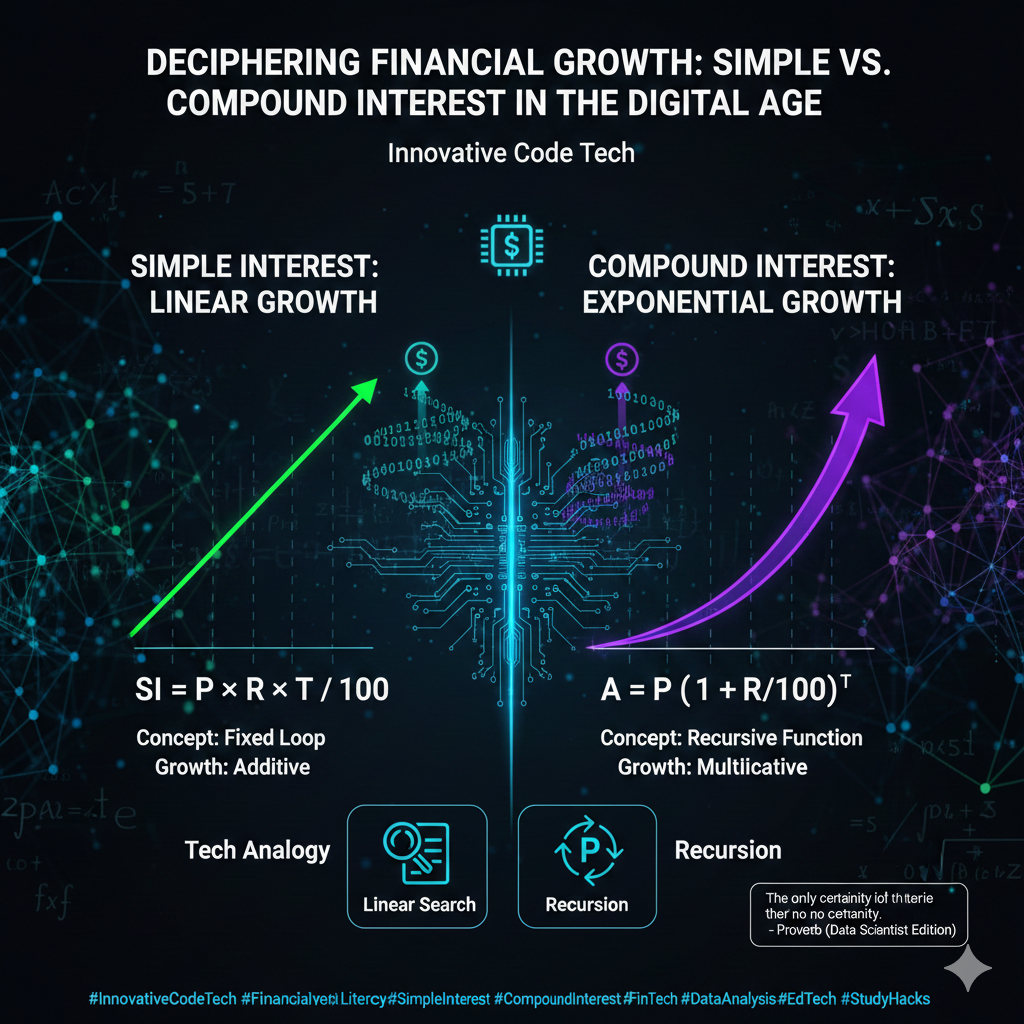
Simple and Compound Interest made clear.
Simple interest adds the same interest each period. Compound interest applies the rate to the growing balance. Keep the rate period and time period consistent.
Key concepts in Simple and Compound Interest
Simple interest
SI = PRT/100 when R is an annual percentage and T is in years. Amount = P + SI.
Compound amount
For annual compounding, A = P(1+r)^n, where r = R/100 and n is the number of years.
Other compounding periods
At a nominal annual rate R compounded half-yearly, use R/2 per half-year and 2T periods.
Changing annual rates
Multiply the successive growth factors; do not replace different rates with a simple average.
Interest growth on ₹10,000 at 10%
| Time | Simple-interest amount | Annual compound amount |
|---|---|---|
| Start | ₹10,000 | ₹10,000 |
| After 1 year | ₹11,000 | ₹11,000 |
| After 2 years | ₹12,000 | ₹12,100 |
A reliable solving method
- Identify principal, rate, duration and compounding frequency.
- Convert months into years for annual simple interest.
- Find the amount first for compound interest, then subtract principal.
- Keep extra decimal places until the final answer.
Step-by-step solved examples
Find SI on ₹5,000 at 8% per year for 3 years.
- SI = 5000 × 8 × 3 / 100.
- Interest is ₹1,200.
- Amount = ₹5,000 + ₹1,200 = ₹6,200.
Find CI on ₹10,000 at 10% annually for 2 years.
- After year 1: 10000 × 1.10 = ₹11,000.
- After year 2: 11000 × 1.10 = ₹12,100.
- CI = 12100−10000 = ₹2,100.
₹8,000 earns 12% nominal annual interest, compounded half-yearly for 1 year.
- There are two periods, each at 6%.
- Amount = 8000 × 1.06² = ₹8,988.80.
- Compound interest = ₹988.80.
Simple and Compound Interest: practice questions
Choose one answer before opening the explanation. Write down your reasoning as well as the option; a correct guess is different from a method you can repeat.
SI on ₹2,000 at 5% for 2 years?
Show answer and explanation — question 1
Answer C: ₹200
2000 × 5 × 2 / 100 = ₹200.
Amount on ₹1,000 at 10% CI annually for 2 years?
Show answer and explanation — question 2
Answer C: ₹1,210
1000 × 1.1² = ₹1,210.
SI is ₹300 at 5% for 3 years. Principal?
Show answer and explanation — question 3
Answer C: ₹2,000
P = 300 × 100 /(5 × 3) = ₹2,000.
Six months equals how many years?
Show answer and explanation — question 4
Answer B: 0.5
6/12 = 0.5 year.
At 10% for 2 years, CI minus SI on ₹1,000?
Show answer and explanation — question 5
Answer B: ₹10
CI = ₹210 and SI = ₹200.
Nominal annual 8%, quarterly compounding: rate per quarter?
Show answer and explanation — question 6
Answer A: 2%
Divide the nominal annual rate by four.
Frequently asked questions
Are amount and interest the same?
No. Amount includes the original principal; interest is the extra sum.
Does compounding frequency matter?
Yes. The number of periods and rate per period both change. These are mathematical examples, not investment return promises.
Identify principal, rate, duration and compounding frequency. Keep extra decimal places until the final answer.