
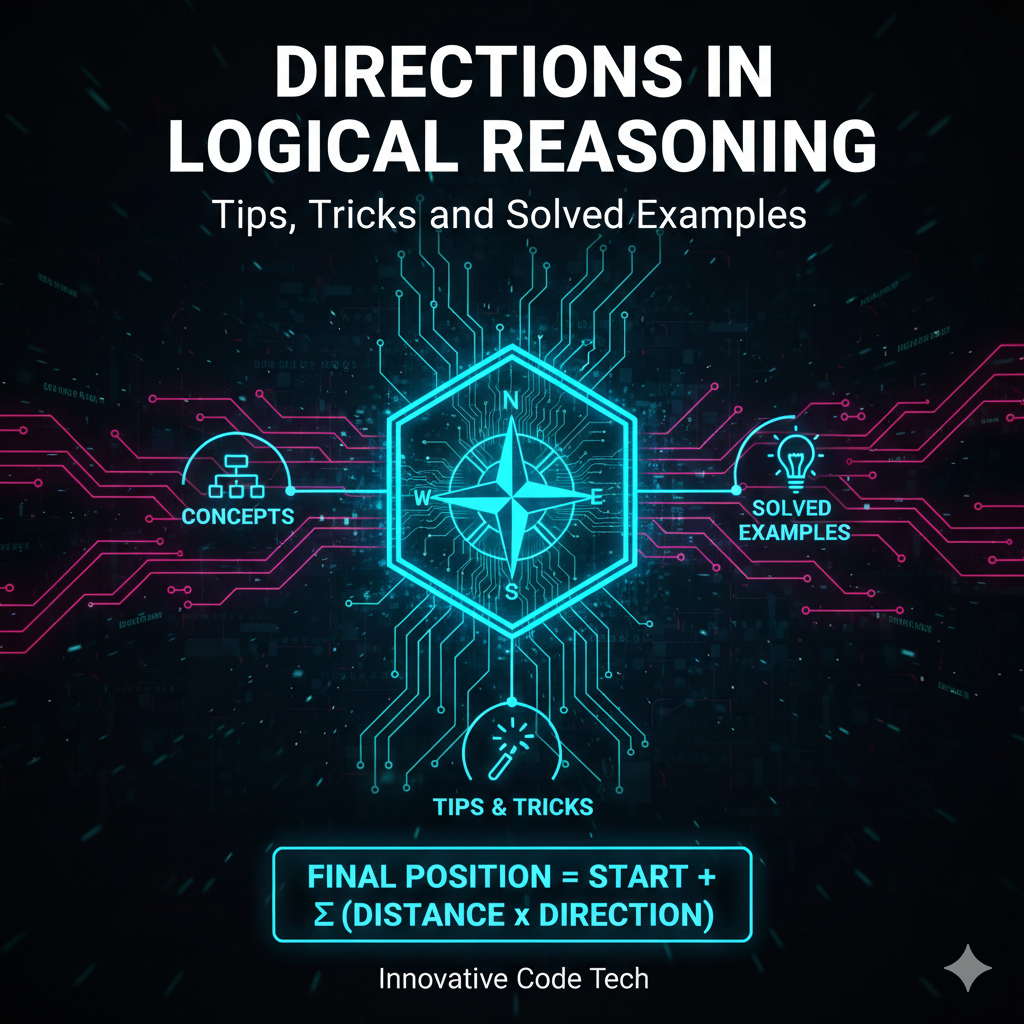
Direction Sense made clear.
Separate the direction you face from the position you reach. A compass and two running coordinates are enough to solve most direction-and-distance problems.
Key concepts in Direction Sense
Compass
North is up, east right, south down and west left on the usual diagram.
Turns
A right turn is 90° clockwise from the current facing direction; a left turn is 90° anticlockwise.
Net displacement
East minus west gives horizontal displacement; north minus south gives vertical displacement.
Shortest distance
For perpendicular displacements x and y, straight-line distance = √(x²+y²). Travelled distance is the sum of route segments.
Track the route on coordinates
| Movement | x: east minus west | y: north minus south |
|---|---|---|
| Start | 0 | 0 |
| 6 m north | 0 | 6 |
| 8 m east | 8 | 6 |
| 6 m south | 8 | 0 |
A reliable solving method
- Mark the start as (0,0), east positive x and north positive y.
- Update facing direction before moving after a turn.
- Cancel opposing movements to find final coordinates.
- Answer the requested quantity: final facing, direction from start, route length or shortest distance.
Step-by-step solved examples
Walk 3 km east, then 4 km north. How far from the start?
- Final coordinates are (3,4).
- Shortest distance = √(3²+4²) = 5 km.
- The route length is 7 km; final position is northeast.
Face north; turn right, then right, then left. Final facing?
- First right: east.
- Second right: south.
- Left from south: east.
Walk 6 m north, 8 m east, 6 m south. Where are you?
- North and south movements cancel.
- Horizontal displacement is 8 m east.
- You are 8 m east of the start, though you walked 20 m.
Direction Sense: practice questions
Choose one answer before opening the explanation. Write down your reasoning as well as the option; a correct guess is different from a method you can repeat.
Facing east, turn left. Now facing?
Show answer and explanation — question 1
Answer A: North
An anticlockwise quarter-turn from east points north.
5 km west then 5 km east: displacement?
Show answer and explanation — question 2
Answer A: 0 km
The final position equals the start.
6 m north then 8 m east: shortest distance?
Show answer and explanation — question 3
Answer B: 10 m
√(36+64)=10 m.
Facing south, turn right. Now facing?
Show answer and explanation — question 4
Answer C: West
Clockwise from south is west.
4 east, 3 west, 2 north: direction from start?
Show answer and explanation — question 5
Answer D: Northeast
Net is 1 east and 2 north.
3 m north then 4 m east: distance travelled?
Show answer and explanation — question 6
Answer C: 7 m
Route length adds the two segments: 7 m.
Frequently asked questions
Is displacement always shorter than the route?
Its magnitude cannot exceed the distance travelled; it can equal it for straight motion in one direction.
Can I use the Pythagorean theorem for any two segments?
Only when the net horizontal and vertical components are perpendicular, or the problem otherwise gives a right triangle.
Mark the start as (0,0), east positive x and north positive y. Answer the requested quantity: final facing, direction from start, route length or shortest distance.