
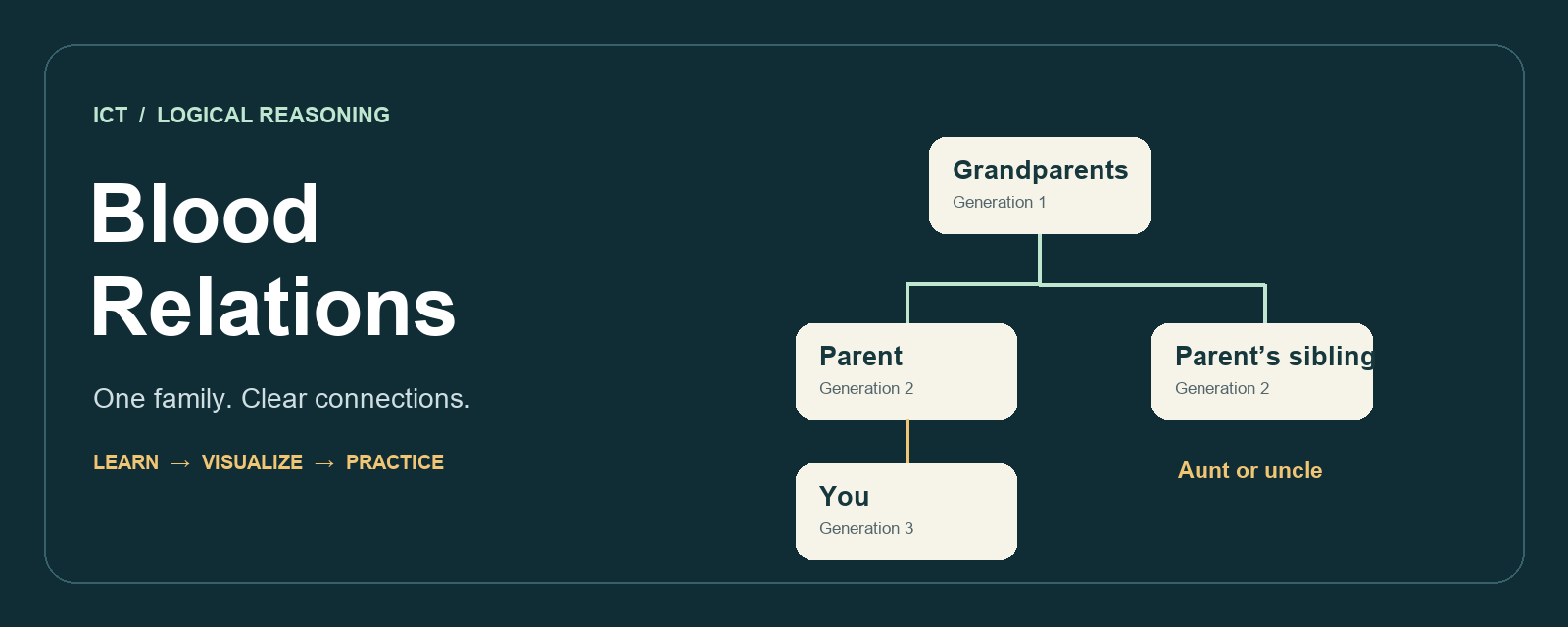
Turn a confusing sentence into a simple family tree.
Learn to track generations, read relationships in the right direction, and spot missing information. Then try ten practice questions with explanations.
What are blood relation problems?
These reasoning questions describe connections between people and ask you to identify a relationship. The puzzle may include relatives by birth and relationships through marriage, such as a spouse or an in-law. Use the facts in the question to build the family, one connection at a time.
Your quick relationship guide
| Follow this connection | Relationship to you |
|---|---|
| Your mother’s brother | Maternal uncle |
| Your father’s sister | Paternal aunt |
| Your sibling’s son / daughter | Nephew / niece |
| Your parent’s sibling’s child | Cousin |
| Your child’s husband / wife | Son-in-law / daughter-in-law |
| Your spouse’s father / mother | Father-in-law / mother-in-law |
Maternal means through the mother’s side; paternal means through the father’s side. A marriage link stays on the same generation level. A parent-to-child link moves down one level.
Read a family tree in three levels
In this example, Ravi and Latha are spouses and the parents of both Meena and Arun. Meena is Tara’s mother. Arun is Dev’s father. These are explicit facts of the example.
On paper: use M for a known male, F for a known female, and ? for unspecified gender. Write “spouse” or “sibling” beside horizontal connections and use a downward arrow for parent → child. Your notation is a memory aid; a coded question’s own symbol definitions always take priority.
Solve the question in four steps
- Circle the two people in the question.
Write “A’s relationship to B” so you keep the direction clear.
- Translate one fact at a time.
“X is Y’s father” gives X → Y and marks X male. It says nothing about Y’s gender.
- Place each person on a generation level.
Keep siblings together. Move down for children and up for parents. Label marriage separately.
- Trace the path and check the evidence.
Confirm the required gender and the direction. If a necessary fact is missing, the exact relationship may not be determinable.
Four solved examples, step by step
A direct relationship chain
Question: A is the mother of B. B is the father of C. How is A related to C?
- A is one generation above B.
- B is one generation above C.
- A is two generations above C and is female.
Answer: Grandmother. C’s gender is irrelevant to A’s relationship with C.
A statement about a photograph
Question: A woman named Sita points to a boy and says, “He is the son of my father’s only daughter.” How is Sita related to the boy?
- The speaker is Sita, who is explicitly a woman.
- Her father’s only daughter must be Sita herself.
- The boy is Sita’s son.
Answer: Mother. Start with the speaker and simplify the inner phrase before tracing the next relationship.
Decode symbols without doing arithmetic
Codes: X + Y means X is the mother of Y. X × Y means X is the brother of Y.
Question: In P × Q + R, how is P related to R?
- P × Q: P is Q’s brother, so P is male.
- Q + R: Q is R’s mother.
- P is the brother of R’s mother.
Answer: Maternal uncle. Treat each symbol as a relationship label. Multiplication or addition precedence does not apply.
Know when information is missing
Question: K is a parent of L. L is the father of M. Is K M’s grandfather or grandmother?
- K → L → M establishes a grandparent relationship.
- “Parent” does not identify K’s gender.
- L being male gives no information about K’s gender.
Answer: Grandparent; the exact gendered term cannot be determined. A name, letter, or position in a diagram is not evidence of gender.
Common traps to avoid
When a question says two people are siblings under the usual full-sibling convention, their parent links are shared. In this lesson’s practice questions, any shared-parent fact needed for an answer is stated or the question avoids relying on it.
Practice: 10 blood relation MCQs
Choose A, B, C, or D on paper, then open the answer. Try to explain the family path before checking. Each correct answer earns one point; keep your own score out of ten.
Ravi is the father of Meena. Meena is the mother of Tara. How is Ravi related to Tara?
Reveal answer & explanation — Q1
B. Grandfather
Ravi → Meena → Tara has two parent-to-child steps. Ravi is male, so he is Tara’s grandfather.
Anu is the sister of Bina. Bina is the mother of Dev. How is Anu related to Dev?
Reveal answer & explanation — Q2
C. Maternal aunt
Anu is the sister of Dev’s mother. That makes Anu his maternal aunt; Dev’s gender is not needed.
A is the brother of B. B is the parent of C. How is A related to C?
Reveal answer & explanation — Q3
A. Uncle
Brother establishes A as male. A is the male sibling of C’s parent, so A is C’s uncle. B’s gender is not needed.
P is a parent of Q. Q is the sister of R. P is also a parent of R. How is P related to R?
Reveal answer & explanation — Q4
D. Parent; gender not given
P is explicitly R’s parent. Nothing states P’s gender, so choosing father or mother would add an assumption.
A woman named Sita says, “The boy is the son of my father’s only daughter.” How is Sita related to the boy?
Reveal answer & explanation — Q5
B. Mother
Sita is a daughter of her father. Since he has only one daughter, that daughter is Sita. The boy is her son.
Here A + B means A is the mother of B, and A × B means A is the brother of B. What does P × Q + R establish about P and R?
Reveal answer & explanation — Q6
C. P is R’s maternal uncle
P × Q: P is Q’s brother. Q + R: Q is R’s mother. P is the brother of R’s mother, or maternal uncle.
Maya and Neha are sisters. Maya is the mother of Arun. Neha is the mother of Bela. How are Arun and Bela related?
Reveal answer & explanation — Q7
B. Cousins
Their mothers are sisters. Children of siblings are cousins. Neither child’s gender changes this answer.
A is the mother of B. B is the father of C. How is C related to A?
Reveal answer & explanation — Q8
D. Grandchild; gender not given
C is two generations below A, so C is A’s grandchild. C’s gender is not stated. Do not reverse the question and answer grandmother.
R is the daughter of S. T is the husband of R. How is T related to S?
Reveal answer & explanation — Q9
A. Son-in-law
T is the husband of S’s daughter. He is S’s son-in-law. S’s gender does not affect this relationship.
A man says, “She is my mother’s only daughter.” How is the woman related to him?
Reveal answer & explanation — Q10
C. Sister
The speaker is male, so he cannot be his mother’s daughter. Her only daughter is his sister. “Only daughter” does not mean “only child”.
Quick answers to common doubts
Can I assume gender from a person’s name?
No. Use an explicit relationship word such as father, sister, husband, or daughter, or a direct statement in the question. Otherwise mark gender as unknown.
Does every blood relation question have one definite answer?
No. If a required gender or family link is missing, several answers may fit. “Cannot be determined” is appropriate when the options require information the question does not provide.
How can I get faster without guessing?
Use a consistent notation, simplify one relationship at a time, and check the question’s direction before choosing. Accuracy comes first; time your practice after you can explain your answers.