
Learn Simple Interest and Compound Interest - Aptitude Questions & Answers
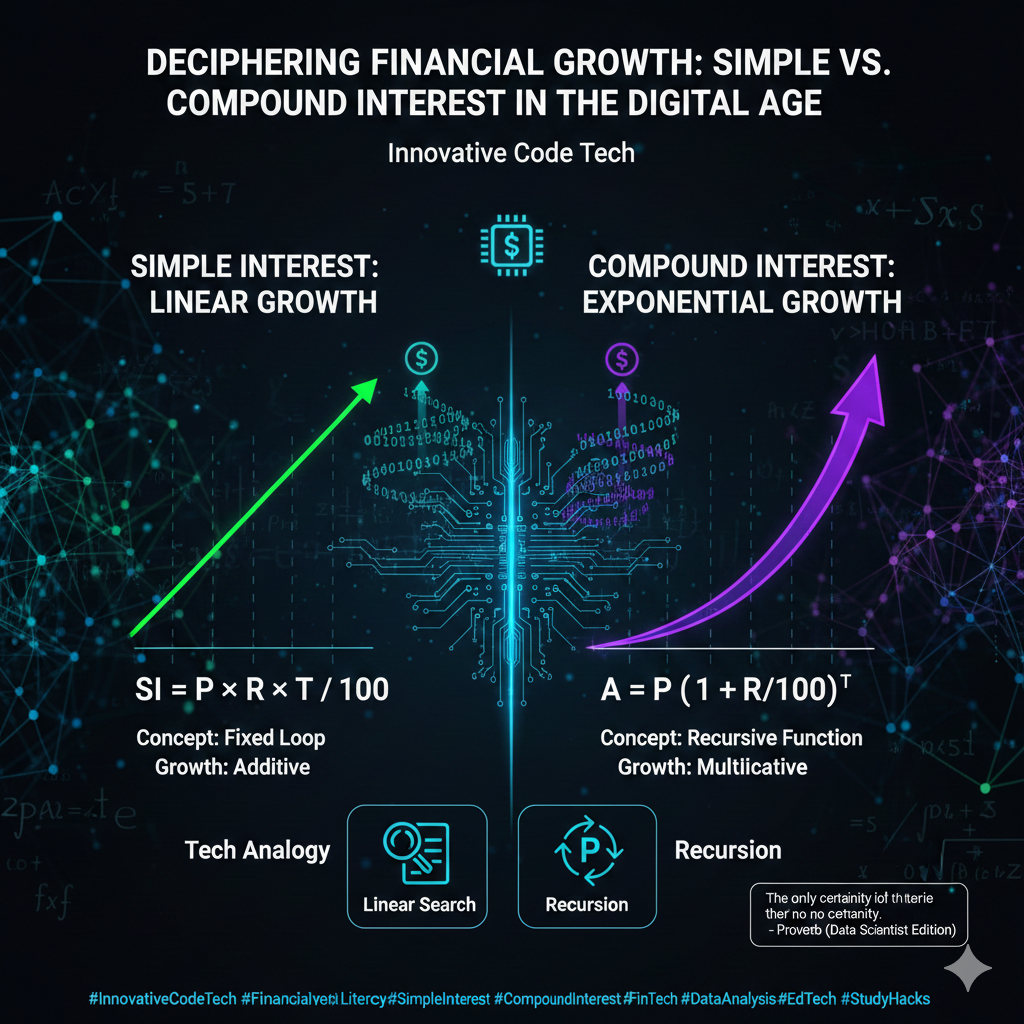
Learn Simple Interest and Compound Interest is one of the most important topics in Quantitative Aptitude. In this lesson, you will learn concepts, formulas, shortcuts, solved examples, and aptitude questions with answers. This topic is useful for exams like SSC, Bank, CAT, TCS, and other competitive exams.
Master interest calculations for aptitude tests with this comprehensive guide covering Simple Interest (SI) and Compound Interest (CI). Learn formulas, shortcuts, and practical applications for loans, investments, and competitive exams.
Simple Interest & Compound Interest: Complete Guide
What is Simple Interest (SI)?
Simple Interest is the extra money paid or earned on a loan or investment. It\'s calculated as a fixed percentage of the principal amount each year.
Where:
- P = Principal (initial borrowed/invested amount)
- R = Rate of Interest (percentage per year)
- T = Time (in years)
What is Amount in Simple Interest?
Amount is the total sum to be repaid, including both principal and accumulated interest.
Example: Find SI and Amount on ₹1000 deposited for 4 years at 6% per annum.
Given:
- P = ₹1,000
- R = 6% p.a.
- T = 4 years
Calculation:
Simple Interest for Different Time Periods
When Time is in Months
Convert months to years by dividing by 12, then use standard formula.
Example: SI on ₹10,000 for 9 months at 5% p.a.
SI = (10000 × 5 × 9) / (12 × 100) = ₹375
When Time is in Days
Convert days to years by dividing by 365, then use standard formula.
Example: SI on ₹5,000 for 73 days at 5% p.a.
SI = (5000 × 5 × 73) / (365 × 100) = ₹50
Important Concept: Multiple Times Principle
If a sum becomes m times in a years, find when it becomes n times.
Therefore: y = a(n - 1)/(m - 1)
Example: A sum becomes 4 times in 9 years at SI. When will it become 6 times?
Given:
- m = 4, a = 9 years
- n = 6, y = ?
Solution:
y = 9 × 5/3 = 15 years
Compound Interest (CI)
What is Compound Interest?
Compound Interest calculates interest on both the principal and previously accumulated interest. It\'s denoted by CI.
Key Formula for Amount:
(for annual compounding)
Where:
- A = Final Amount
- P = Principal
- r = Annual interest rate (%)
- t = Time in years
Two Methods to Calculate CI
Method 1: Using Simple Interest (Step-by-Step)
- Calculate SI for first period (usually 1 year)
- Add this interest to principal → New principal
- Calculate SI on new principal for next period
- Repeat for all periods
- Total CI = Final Amount - Original Principal
Example: ₹1,000 at 5% CI annually for 2 years
Year 1:
- SI = (1000 × 5 × 1)/100 = ₹50
- New Principal = 1000 + 50 = ₹1,050
Year 2:
- SI = (1050 × 5 × 1)/100 = ₹52.50
- Final Amount = 1050 + 52.50 = ₹1,102.50
Total CI:
Method 2: Using Direct Formula
Same Example: ₹1,000 at 5% CI for 2 years
CI = 1000[1 + (5/100)]² - 1000 = ₹102.50
Different Compounding Periods
Half-Yearly Compounding
Interest compounded every 6 months. Rate becomes half, time doubles.
CI = A - P
Example: ₹1,000 at 8% p.a. compounded half-yearly for 1 year
Calculation:
Quarterly Compounding
Interest compounded every 3 months. Rate becomes one-fourth, time quadruples.
CI = A - P
Example: ₹10,000 at 8% p.a. compounded quarterly for ½ year
Given: ½ year = 2 quarters
Difference Between CI and SI
| Compound Interest (CI) | Simple Interest (SI) |
|---|---|
| Calculated on principal + accumulated interest | Calculated only on principal |
| Formula: A = P[1 + (r/100)]t | Formula: SI = (P×R×T)/100 |
| CI > SI for same P, R, T (except first year) | SI < CI for same P, R, T |
| Amount grows exponentially | Amount grows linearly |
| Used in investments, loans, savings | Used in short-term loans, simple deposits |
Example: Difference between CI and SI on ₹8,000 at 10% p.a. for 2 years
Simple Interest:
Compound Interest:
Difference:
Frequently Asked Questions
Why is Compound Interest called \"interest on interest\"?
Because CI calculates interest not just on the original principal, but also on the interest that has been added to it in previous periods, leading to exponential growth.
When is Simple Interest better than Compound Interest?
For borrowers taking short-term loans, SI is better as it costs less. For long-term investors, CI is better due to compounding benefits. Always compare based on time period and purpose.
How to quickly calculate CI for 2 or 3 years?
Use shortcut formulas: For 2 years, CI = P[(r/100)² + 2(r/100)]. For 3 years, CI = P[(r/100)³ + 3(r/100)² + 3(r/100)].
What\'s the rule of 72 in compound interest?
Rule of 72 estimates doubling time: Divide 72 by annual interest rate. Example: At 8% CI, money doubles in approximately 72/8 = 9 years.
How does compounding frequency affect returns?
More frequent compounding (quarterly > half-yearly > annually) yields higher returns because interest is calculated and added more often, leading to faster compounding.
Related Financial Concepts
Profit & Loss
Learn cost price, selling price, discount calculations and profit percentage formulas.
Percentage Calculations
Master percentage increase/decrease, successive percentages, and base value calculations.
Ratio & Proportion
Understand direct/inverse proportion, partnership, and mixture problems.
Banking & Finance
Learn about loans, EMIs, annuities, and other financial instruments.
Frequently Asked Questions
What is Learn Simple Interest and Compound Interest?
Learn Simple Interest and Compound Interest is an important aptitude topic used in competitive exams that tests your logical reasoning and problem-solving abilities.
Is Learn Simple Interest and Compound Interest important for competitive exams?
Yes, Learn Simple Interest and Compound Interest is frequently asked in SSC, Bank, CAT, TCS, and other placement exams. It's essential to master this topic for better scores.
How to prepare Learn Simple Interest and Compound Interest easily?
Practice solved examples, learn formulas and shortcuts, and attempt practice questions regularly to master Learn Simple Interest and Compound Interest.
What are the important formulas in Learn Simple Interest and Compound Interest?
Key formulas vary by topic, but generally include basic concepts, shortcuts, and standard problem-solving approaches specific to Learn Simple Interest and Compound Interest.
How many questions come from Learn Simple Interest and Compound Interest?
Typically 5-10 questions come from Learn Simple Interest and Compound Interest in most competitive exams, making it a high-scoring section.
Related Learning & Career Resources
Quantitative Aptitude Aptitude Questions
Practice all Quantitative Aptitude aptitude questions with answers and shortcuts.
Quantitative Aptitude Interview Questions
Prepare HR & technical interview questions asked for freshers and experienced.
Latest Jobs After Aptitude Preparation
Apply for latest fresher & work-from-home jobs after aptitude practice.