
Learn Ratios and Proportion - Aptitude Questions & Answers
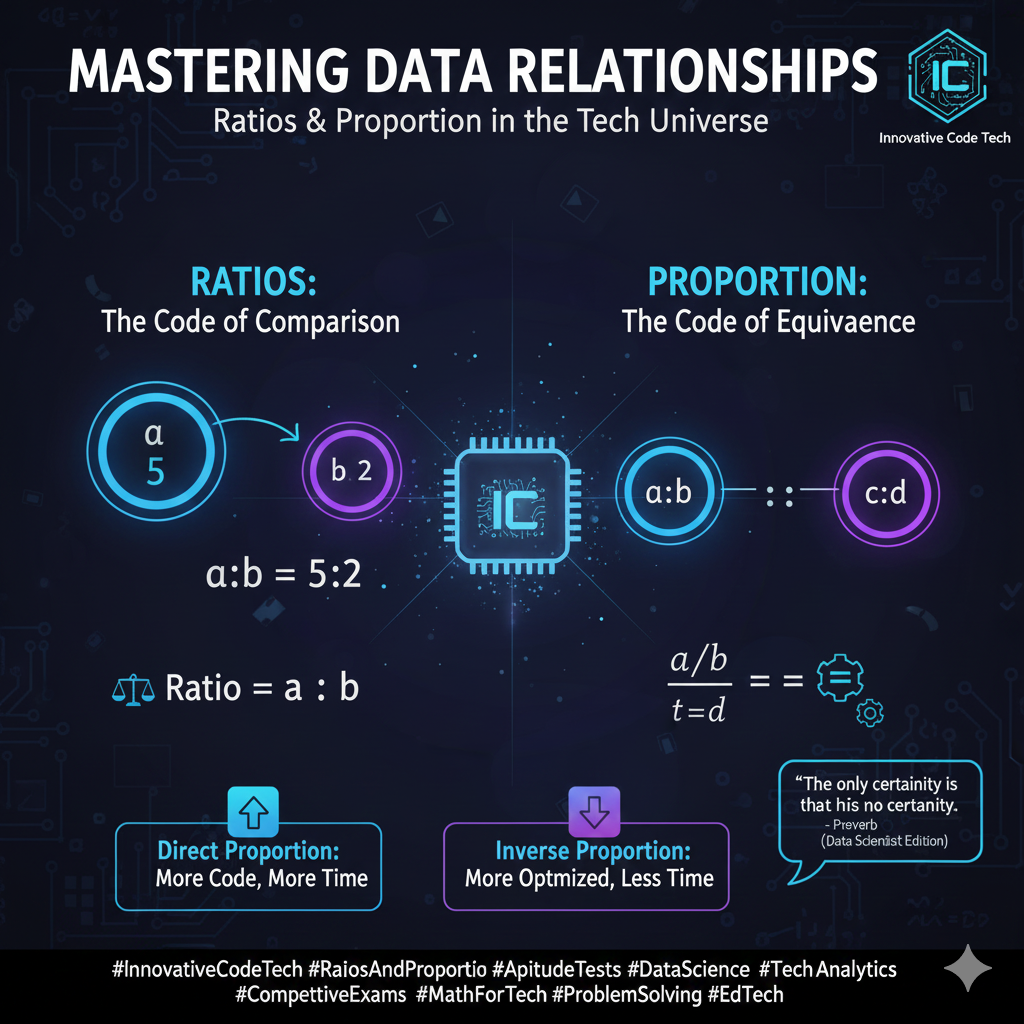
Learn Ratios and Proportion is one of the most important topics in Quantitative Aptitude. In this lesson, you will learn concepts, formulas, shortcuts, solved examples, and aptitude questions with answers. This topic is useful for exams like SSC, Bank, CAT, TCS, and other competitive exams.
Master ratio and proportion concepts essential for aptitude tests and real-world applications. Learn properties, manipulation techniques, and problem-solving strategies with practical examples for competitive exams.
Ratio and Proportion: Complete Guide with Examples
What is Ratio?
Ratio compares two or more quantities of the same unit. It\'s a unitless quantity expressed as a relationship between numbers.
Key Terms:
- a = Antecedent (first term)
- b = Consequent (second term)
Ratio of Two Quantities
How to Simplify Ratios:
- Find HCF (Highest Common Factor) of both numbers
- Divide both terms by HCF
- Express in simplest form
Example 1: 4 apples and 2 oranges. Find apple to orange ratio.
Step 1: Write ratio
Step 2: Find HCF
Step 3: Simplify
Example 2: 15 men and 10 women. Find men to women ratio.
HCF(15, 10) = 5
(15÷5) : (10÷5) = 3 : 2
Ratio of Three Quantities
Simplification Method:
- Find HCF of all three numbers
- Divide each term by HCF
- Express in simplest form
Example 1: 9 guavas, 6 bananas, 3 pineapples
HCF(9, 6, 3) = 3
(9÷3) : (6÷3) : (3÷3) = 3 : 2 : 1
Example 2: 20 black, 10 blue, 4 green balls
HCF(20, 10, 4) = 2
(20÷2) : (10÷2) : (4÷2) = 10 : 5 : 2
Properties of Ratios
Property 1: Multiplication Invariance
Multiplying both terms by same number doesn\'t change ratio.
Property 2: Division Invariance
Dividing both terms by same number doesn\'t change ratio.
Property 3: Reciprocal Equality
If ratios are equal, their reciprocals are also equal.
Property 4: Cross Multiplication
Equal ratios have equal cross products.
Property 5: Same Ratio, Different Values
Ratios can be same but actual values different.
20:30 = 5:6 and 150:180 = 5:6
Ratio 5:6 is same, but actual values differ
Manipulation of Ratios
Combining Ratios
To combine two ratios a:b and b:c into a single ratio a:b:c, make the common term (b) equal in both ratios.
Step-by-Step Method:
- Identify common term in both ratios
- Find LCM of common term values
- Multiply each ratio to make common terms equal
- Combine into single ratio
Example: Given a:b = 2:3 and b:c = 5:6, find a:b:c
Step 1: Common term is b
Step 2: Values of b are 3 and 5. LCM(3,5) = 15
Step 3: Make b = 15 in both ratios
For b:c = 5:6, multiply by 3 → 15:18
Step 4: Combine
Proportion
What is Proportion?
Two ratios are proportional when they are equal to each other.
Key Terms in Proportion:
- Extreme Terms: a and d (first and last)
- Mean Terms: b and c (middle terms)
Properties of Proportion
Property 1: Cross Product Rule
Product of extremes = Product of means
Property 2: Alternendo
Switching means positions
Example 1: Find x if x:5 is proportional to 12:30
Given: x : 5 :: 12 : 30
Using cross product rule:
30x = 60
x = 60 ÷ 30 = 2
Example 2: Anuj and Anil salaries ratio = 1:2. After ₹4,000 increase each, new ratio = 3:4. Find Anuj\'s original salary.
Step 1: Let original salaries be 1x and 2x
Step 2: After increase:
Anil\'s new salary = 2x + 4000
Step 3: New ratio given:
Step 4: Cross multiply:
4x + 16000 = 6x + 12000
16000 - 12000 = 6x - 4x
4000 = 2x
x = 2000
Step 5: Anuj\'s original salary:
Frequently Asked Questions
What\'s the difference between ratio and fraction?
A ratio compares quantities (a:b), while a fraction represents part of a whole (a/b). Ratios are unitless, while fractions have units of the quantities involved.
How to simplify ratios with decimals or fractions?
Multiply all terms by a common factor to eliminate decimals/fractions. For example, 0.5:1.25 becomes 5:12.5, then multiply by 2 → 10:25, simplify to 2:5.
What is continued proportion?
When a:b = b:c, then a, b, c are in continued proportion. Here b is the mean proportional between a and c (b² = a × c).
How to solve ratio problems with changing quantities?
Always set up original quantities as multiples of ratio terms. When quantities change, create equations based on new ratios and solve for the multiplier.
What are equivalent ratios?
Ratios that represent the same relationship when simplified. Example: 2:3, 4:6, 6:9, 8:12 are all equivalent to 2:3.
Related Mathematical Concepts
Percentage
Learn percentage calculations, increase/decrease, and applications in profit-loss.
Partnership
Understand profit sharing, investment ratios, and business partnership calculations.
Mixture & Alligation
Master mixture problems, weighted averages, and alligation rule applications.
Profit & Loss
Learn cost price, selling price, discount, and profit percentage calculations.
Frequently Asked Questions
What is Learn Ratios and Proportion?
Learn Ratios and Proportion is an important aptitude topic used in competitive exams that tests your logical reasoning and problem-solving abilities.
Is Learn Ratios and Proportion important for competitive exams?
Yes, Learn Ratios and Proportion is frequently asked in SSC, Bank, CAT, TCS, and other placement exams. It's essential to master this topic for better scores.
How to prepare Learn Ratios and Proportion easily?
Practice solved examples, learn formulas and shortcuts, and attempt practice questions regularly to master Learn Ratios and Proportion.
What are the important formulas in Learn Ratios and Proportion?
Key formulas vary by topic, but generally include basic concepts, shortcuts, and standard problem-solving approaches specific to Learn Ratios and Proportion.
How many questions come from Learn Ratios and Proportion?
Typically 5-10 questions come from Learn Ratios and Proportion in most competitive exams, making it a high-scoring section.
Related Learning & Career Resources
Quantitative Aptitude Aptitude Questions
Practice all Quantitative Aptitude aptitude questions with answers and shortcuts.
Quantitative Aptitude Interview Questions
Prepare HR & technical interview questions asked for freshers and experienced.
Latest Jobs After Aptitude Preparation
Apply for latest fresher & work-from-home jobs after aptitude practice.