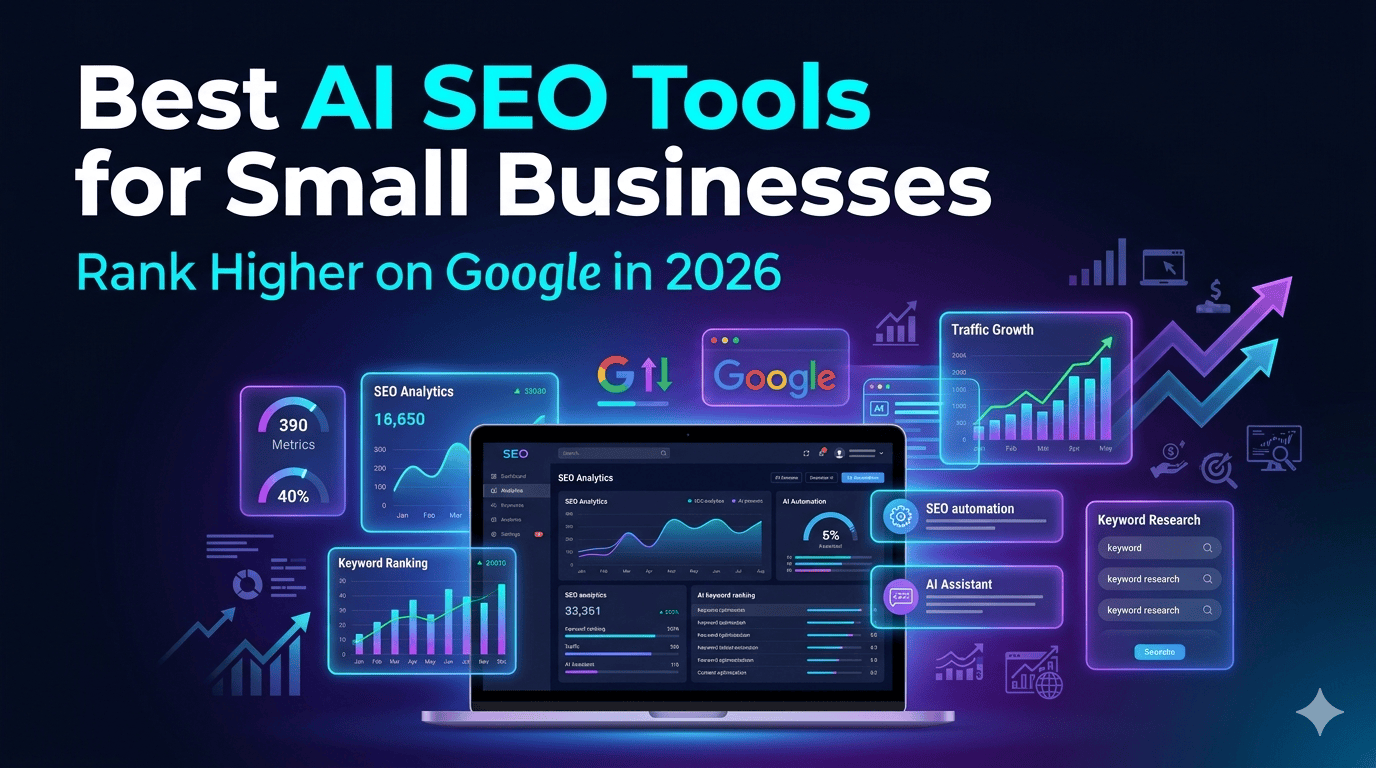
Have you ever poured hours into your website—writing pages, tweaking titles, adding content—only to check Google and find yourself buried on page four? You're not alone. Most small business owners face exactly this problem. The frustrating part? Your competitors aren't necessarily smarter or working harder. They're just using better tools. Specifically, the best AI SEO tools that automate the grunt work, surface real opportunities, and help pages actually rank.
The good news: small business SEO has never been more accessible. AI has flipped the game. What used to require a full-time SEO agency—technical audits, keyword gap analysis, content optimization, backlink tracking—can now be done by a solo founder with the right AI SEO platform. In this guide, we're breaking down the top tools, what they actually do, what they cost, and how to pick the right one for your business. No fluff. No generic advice. Just what works in 2026.
Why Small Businesses Struggle With SEO (And Why AI Changes Everything)
Let's be real—traditional SEO is a grind. You have to do keyword research, competitor analysis, technical site audits, write SEO copy, build backlinks, and then wait months to see if any of it worked. For a small business owner juggling a dozen other priorities, that's simply not sustainable.
Here's the kicker: Google processes over 8.5 billion searches every day. That's 8.5 billion opportunities for someone to find your business—or your competitor's. The difference between ranking on page one versus page four isn't luck. It's about strategy. And the strategy in 2026 is about using AI-powered SEO tools that work smarter, not harder.
AI changes the equation in three big ways. First, it dramatically slashes research time. Keyword analysis that used to take a full day now takes minutes. Second, it identifies patterns humans miss—competitor content gaps, semantic keyword clusters, and on-page optimization signals. Third, it scales content production without sacrificing quality. One person with the right SEO automation tools can now do what a five-person agency team could not do a few years ago.
The businesses that win in local search aren't outspending the competition—they're out-optimizing them with smarter tools and tighter execution.
If you've been hesitant about AI marketing tools because they seem complicated or expensive, this guide will change your mind. We've tried and reviewed the best platforms so you can make an informed, confident decision. And if you're also working on broader digital growth, check out our deep-dive on AI search optimization strategies for 2026—it pairs well with everything we cover here.
What to Look For in AI SEO Tools for Small Businesses
Not every SEO software is built with small businesses in mind. Some tools are enterprise-grade monsters that'll overwhelm you with data and drain your budget. Before we get into specific recommendations, here's what actually matters when you're a small business owner evaluating AI-based SEO tools.
Ease of Use
You shouldn't need an SEO certification to use the tool. The best platforms offer clear dashboards, guided workflows, and actionable recommendations—not just raw data dumps. If you open the tool and immediately feel lost, that's a red flag.
Keyword Research Capabilities
Solid keyword research tools are non-negotiable. You want a platform that shows you search volume, keyword difficulty (KD), CPC data, and—crucially—related and long-tail variations. Low KD, high volume, and decent CPC are the sweet spot for small businesses competing against larger brands.
Content Optimization
The best SEO content writing tools don't just tell you to "add more keywords." They analyze the top-ranking pages, identify what topics they cover, and give you a blueprint to write something definitively better. Look for tools with content scoring, NLP optimization, and competitor comparison features.
Technical SEO Audit
Broken links. Slow page speed. Missing meta tags. Duplicate content. These technical issues are silently killing your rankings. A good SEO audit tool crawls your site regularly and flags problems with clear fix instructions.
Local SEO Features
If you serve a specific geographic area, local SEO for small businesses is critical. Look for tools that integrate with Google Business Profile, support local keyword tracking, and manage citations. Local small business SEO has its own playbook—make sure your tool supports it.
Pricing That Makes Sense
Affordable doesn't mean cheap. It means getting solid ROI. For most small businesses, spending $50–$150/month on a capable SEO platform is completely justifiable if it drives even a handful of new customers monthly. We've noted pricing for every tool below.
The 8 Best AI SEO Tools for Small Businesses in 2026
We evaluated over 20 tools across keyword research, content optimization, technical auditing, and reporting. These eight stood out as the best options for small businesses at different stages and budgets.
1. Semrush — Best All-in-One AI SEO Platform
Semrush is the gold standard for comprehensive SEO software. Its AI-powered features—Keyword Magic Tool, SEO Writing Assistant, and ContentShake AI—cover everything from Semrush keyword research to fully optimized, search-intent-driven content drafts. The platform pulls data from its massive database of over 25 billion keywords, giving you incredibly accurate search volume and difficulty scores.
- Best for: Small businesses wanting an all-in-one solution for keyword research, site audits, and content optimization
- Standout feature: ContentShake AI generates SEO-optimized articles with competitor gap analysis baked in
- Pricing: Pro plan starts at $139.95/month (limited features on free plan available)
- Local SEO: Yes—listing management and local rank tracking included in higher tiers
The Semrush AI writing assistant integrates directly with Google Docs and WordPress, making it genuinely practical for content teams. One drawback: the learning curve is real. Plan for a week or two before you're using it efficiently. That said, for serious search engine optimization for small businesses, Semrush delivers unmatched depth.
2. Ahrefs — Best for Backlink Analysis and Keyword Research
Ahrefs built its reputation on having the industry's most accurate backlink index and has since evolved into a comprehensive AI-powered SEO platform that delivers excellent results. Even before you pay for a plan, the Ahrefs keyword generator is one of the best free keyword research tools available. Its paid tiers offer competitor analysis, content gap reports, and site auditing that rival Semrush.
- Best for: Businesses aiming to prioritize link building and understand competitor strategies
- Standout feature: Content Explorer finds successful content ideas using backlink and traffic data
- Pricing: Lite plan at $129/month; free Ahrefs Webmaster Tools available for site owners
- Local SEO: Basic—keyword tracking is functional locally, but there are no dedicated local features
3. Surfer SEO — Best for Content Optimization
Surfer SEO AI takes a different angle. Instead of being a research powerhouse, it focuses laser-sharp on improving your existing content. You paste your draft in, tell it the target keyword, and it scores your content against the top 10 competitors. It then tells you exactly what topics to add, what NLP terms to include, how long your article should be, and how many headings to use.
- Best for: Businesses publishing blog content regularly and wanting clear optimization guidance
- Standout feature: Content Editor gives a real-time score as you write, with NLP-driven term suggestions
- Pricing: Essential plan at $99/month; integrates with Jasper AI for full drafting workflows
- Local SEO: Limited—focused on content, not local visibility
If your primary goal is creating content that outranks competitors, Surfer SEO is arguably the best AI content optimization tool on the market right now. Pair it with Ahrefs for research, and you've got a formidable stack.
4. Google Search Console + Google Keyword Planner — Best Free Starting Point
Before spending anything, use Google's own tools. Google Search Console (GSC) shows you which keywords your site already ranks for, which pages get clicks, and where technical issues exist. The Google Keyword Planner (officially the Google Ads Keyword Planner) gives you search volume ranges and CPC data straight from the source.
- Best for: Businesses just starting with SEO who need zero-cost data
- Standout feature: GSC's Performance report reveals exact search queries driving traffic—often surprising
- Pricing: Completely free
- Local SEO: GSC supports local filtering; Google Business Profile is a must-have companion
The Google Ads Keyword Planner has one frustrating quirk: it shows volume ranges (like "1K–10K") rather than exact numbers unless you're running active ad campaigns. Still, for directional research and identifying high-CPC keywords, it's invaluable. And it's free—which is hard to beat when you're just starting out.
5. RankIQ — Best for Bloggers and Content-Heavy Small Businesses
RankIQ was built with bloggers and small publishers in mind. Its AI scans thousands of top-ranking articles in your niche to find the lowest-competition, highest-traffic keywords you should be targeting. Then the content optimizer guides you on what topics to cover for each keyword. It's simpler than Semrush, more specialized, and much more affordable.
- Best for: Content-heavy sites, blogs, and niche affiliate sites
- Standout feature: Pre-built keyword libraries by niche, curated for low KD + high traffic
- Pricing: $99/month with no report limits
- Local SEO: Not built for local SEO—best for topical authority building
6. SE Ranking — Best Budget-Friendly All-Rounder
SE Ranking hits a sweet spot that few tools manage: genuinely useful features at a price that doesn't sting. You get rank tracking, keyword research, site auditing, competitor analysis, and white-label reporting—all for under $50/month on the entry plan. Its AI writing features are newer but improving fast.
- Best for: Budget-conscious small businesses needing broad coverage without breaking the bank
- Standout feature: Rank tracker updates daily and monitors local, mobile, and desktop separately
- Pricing: Essential plan starts at $44/month; scales with keywords tracked
- Local SEO: Strong local rank tracking; Google Business Profile audit included
For affordable SEO services for small businesses that prefer to do it in-house, SE Ranking is genuinely one of the best-value options available. You can read more about pairing your SEO strategy with automation in our guide to the best AI automation tools for small businesses in 2026.
7. Ubersuggest — Best Entry-Level Option
Neil Patel's Ubersuggest is a solid entry-level tool for small businesses dipping their toes into SEO. It covers keyword research, basic site audits, competitor analysis, and content ideas. The lifetime deal pricing makes it particularly attractive if you want to avoid monthly subscriptions. It won't out-feature Semrush or Ahrefs, but for a business just getting started, it's more than enough.
- Best for: Solopreneurs and very small teams new to SEO
- Standout feature: Lifetime plan available (one-time payment) for budget-conscious buyers
- Pricing: Individual plan at $29/month or ~$290 lifetime
- Local SEO: Basic local keyword tracking available
8. Jasper AI + Surfer SEO — Best AI Writing Stack
Jasper AI isn't an SEO tool by itself—it's an AI writing platform. But when integrated with Surfer SEO, it becomes one of the most powerful SEO writing AI workflows available. Jasper drafts long-form content quickly; Surfer scores it and tells you what to fix. Together, they dramatically accelerate the publication of high-quality, optimized articles at scale.
- Best for: Businesses that publish a lot of content and want AI-assisted drafting
- Standout feature: Native Jasper-Surfer integration for real-time SEO scoring inside the AI editor
- Pricing: Jasper Creator at $49/month + Surfer at $99/month
- Local SEO: Not applicable—content-focused workflow
AI SEO Tools Comparison: Side-by-Side Breakdown
Choosing between these tools often comes down to your specific needs and budget. Here's a clear comparison to make that decision easier.
| Tool | Best For | Starting Price | Keyword Research | Content AI | Local SEO | Technical Audit |
|---|---|---|---|---|---|---|
| Semrush | All-in-one | $139.95/mo | ★★★★★ | ★★★★★ | ★★★★☆ | ★★★★★ |
| Ahrefs | Backlinks & Research | $129/mo | ★★★★★ | ★★★☆☆ | ★★☆☆☆ | ★★★★☆ |
| Surfer SEO | Content Optimization | $99/mo | ★★★☆☆ | ★★★★★ | ★☆☆☆☆ | ★★☆☆☆ |
| SE Ranking | Budget All-Rounder | $44/mo | ★★★★☆ | ★★★☆☆ | ★★★★☆ | ★★★★☆ |
| RankIQ | Bloggers / Content Sites | $99/mo | ★★★★☆ | ★★★★☆ | ★☆☆☆☆ | ★★☆☆☆ |
| Ubersuggest | Beginners | $29/mo | ★★★☆☆ | ★★★☆☆ | ★★★☆☆ | ★★★☆☆ |
| Google Tools | Free Starting Point | Free | ★★★☆☆ | ★☆☆☆☆ | ★★★★☆ | ★★★☆☆ |
| Jasper + Surfer | Content Production Scale | $148/mo | ★★★☆☆ | ★★★★★ | ★☆☆☆☆ | ★☆☆☆☆ |
How to Build a Small Business SEO Strategy With AI Tools (Step-by-Step)
Having the tools is one thing. Knowing how to use them together is where most small businesses fall short. Here's a practical, repeatable framework that works regardless of which tools you choose.
Step 1: Fix Technical Issues First
Before you create any content, audit your existing site. Use Semrush Site Audit, SE Ranking, or even Google Search Console to identify crawl errors, broken links, slow-loading pages, and missing meta tags. Technical issues are Google's way of saying "I can't properly read your site"—and you can't rank pages Google can't read. Fix the foundation before building on it.
Common technical fixes to address right now:
- Page speed under 3 seconds on mobile (check with PageSpeed Insights)
- Missing or duplicate title tags and meta descriptions
- Broken internal links (404 errors)
- Missing XML sitemap or robots.txt misconfigurations
- Non-HTTPS pages (still happens more often than you'd think)
If you're building or rebuilding your site from scratch, our guide on how to build a business website that ranks on Google covers the technical groundwork you need to get right from day one.
Step 2: Do Keyword Research the Right Way
Here's where most small businesses make a critical mistake—they go after high-volume, high-competition keywords that dominant brands have locked up for years. Instead, think like a chess player. Target keywords where you can actually win.
The sweet spot for small business keyword targeting in 2026:
- Search volume: 500–5,000 monthly searches (high enough to matter, low enough to compete)
- Keyword difficulty: Under 40 (on a 0–100 scale)
- Search intent: Informational or commercial investigation (not just navigational)
- Local modifier: Include city/region-specific variants for local businesses
Use the Semrush Keyword Magic Tool, Ahrefs Keywords Explorer, or even the free Google Keyword Planner to build your initial list. Then filter ruthlessly. Twenty well-chosen, winnable keywords are worth more than two hundred long shots. Our breakdown of high-CPC niches for 2026 is also useful if you're targeting keywords with strong monetization potential.
Step 3: Create Content That Actually Answers the Question
Google's algorithm has gotten remarkably good at identifying content that genuinely helps users versus content that just stuffs keywords. In 2026, SEO content writing means covering a topic comprehensively, answering related questions, using proper heading structure, and matching the search intent of the keyword.
Workflow we recommend:
- Pick your target keyword and identify the top 5 ranking pages
- Note what topics they cover, what questions they answer, and where they fall short
- Use Surfer SEO or RankIQ to get an optimization score target and NLP term list
- Write a draft (with or without AI assistance) that covers everything competitors missed
- Optimize the draft against your content score before publishing
- Add proper internal links to related content on your site
Content depth beats content length. A 1,500-word article that answers every related question beats a 3,000-word article that paddles in circles.
Step 4: Build Local Signals (If You're a Local Business)
Local SEO for small businesses has its own specific playbook. If you serve customers in a specific city or region, these are non-negotiable:
- Claim and fully optimize your Google Business Profile (photos, hours, services, Q&A)
- Get consistent NAP (Name, Address, Phone) citations across directories
- Build location-specific pages on your website for each service area
- Actively collect and respond to Google reviews
- Use local keywords like "[service] in [city]" throughout your content
Local SEO services for small businesses from agencies can cost $500–$2,000/month. With the right tools, you can handle a significant portion of this yourself—especially the content and on-page work. SE Ranking and Semrush both have solid local tracking features worth exploring.
Step 5: Track, Measure, and Adjust
SEO without tracking is like driving with your eyes closed. At a minimum, you should be monitoring:
- Keyword rankings (weekly or daily via your chosen tool)
- Organic traffic in Google Analytics 4
- Click-through rates in Google Search Console
- Conversion rate from organic traffic (leads, calls, purchases)
- Core Web Vitals scores (directly impact rankings)
Set a monthly review cadence. Look at what's improving, what's stagnant, and where new opportunities are appearing. SEO is a compounding game—consistent small improvements over months deliver outsized results. Businesses that track obsessively outperform those that post-and-forget every single time.
Common SEO Mistakes Small Businesses Make (And How to Avoid Them)
We've worked with many small businesses on their SEO. The mistakes are remarkably consistent. Knowing them in advance saves you months of wasted effort.
Mistake 1: Targeting Keywords You Can't Win
Going after "best CRM software" when you're a startup is like entering a 100m race against Usain Bolt. You're not winning. Instead, target long-tail variations: "best CRM software for freelance consultants" or "CRM software for small plumbing businesses." The volume is lower, but the competition is beatable—and the conversion rate is often higher because the intent is more specific. If you're evaluating CRM options for your own business, our guide to the best CRM software for small businesses in the USA is a solid starting point.
Mistake 2: Ignoring Internal Linking
Internal links are among the most underrated SEO levers available. They pass authority between pages and help Google understand your site's structure. Every time you publish a new piece of content, link to it from relevant existing pages—and link from the new page back to your most important ones. This is free, takes five minutes, and consistently moves rankings.
Mistake 3: Publishing and Abandoning
SEO isn't a set-and-forget task. Pages that don't rank in 3–6 months often just need updating, not replacing. Add new data, expand thin sections, improve the title tag, and build a few internal links to the page. Google prefers freshness signals, and it's often faster and cheaper to refresh and improve old content than to create new content from scratch.
Mistake 4: Skipping the Technical Foundation
We've seen businesses spend thousands on content creation while their site loads in 9 seconds on mobile, has duplicate meta descriptions on every page, and doesn't have a proper sitemap. Fix the technical foundation first. Always. If you're worried about how site speed specifically affects your business in a competitive market, our piece on how slow websites cost Chennai businesses customers breaks down the real cost of performance issues.
Mistake 5: Expecting Overnight Results
This one is painful but important. SEO takes time. New websites typically take 6–12 months to see significant organic traffic. Established sites with existing authority might see improvements in 2–4 months from fresh optimizations. Anyone promising page-one rankings in 30 days is selling something you don't want to buy. Set realistic expectations, stay consistent, and the results will come.
Advanced SEO Tips for Small Businesses in 2026
If you've covered the basics, these advanced strategies separate the good from the great. These are the moves serious small business SEO practitioners use to build durable, defensible organic traffic.
Build Topical Authority, Not Just Individual Articles
Google increasingly ranks sites that demonstrate deep expertise in a specific topic cluster. Instead of writing one-off articles, build content hubs. A plumber in Austin might create a comprehensive hub on "Austin plumbing problems"—with pillar content covering the main topic and supporting articles on subtopics like "why Austin water is hard on pipes" or "winter freeze pipe protection in Texas."
This topical authority strategy signals to Google that your site is the authoritative resource for a topic—rather than a random article that happens to rank. It takes more work upfront, but pays off in compounding returns as each article supports the others.
Optimize for AI Overviews and Featured Snippets
Google's AI Overviews (formerly Search Generative Experience) are changing how searchers consume results. To be featured in AI Overviews, structure your content with clear, straight-to-the-point answers to questions—especially at the beginning of the article. Use concise definitions, numbered steps, and comparison tables. These formats are exactly what featured snippets and AI Overviews pull from.
This is directly tied to the changing world of AI search optimization—if you're not optimizing for how AI systems consume your content, you're missing out on significant visibility.
Leverage Schema Markup
Schema markup is code you add to your pages that helps Google better understand your content. For small businesses, the most impactful schema types are:
- LocalBusiness schema — tells Google your address, hours, and service area
- FAQ schema — surfaces your Q&A content in search results
- Review schema — displays star ratings in search results (if applicable)
- HowTo schema — for instructional content
Most modern WordPress themes support schema natively, or you can use a plugin like Rank Math or Yoast to add it without coding. It's a relatively small investment that can meaningfully improve your click-through rates from search results.
Use AI to Scale Content Without Losing Quality
The fear that AI-generated content is automatically low-quality is outdated. The businesses winning with AI-assisted content use it as a drafting and research accelerator—not a replacement for human editorial judgment. The workflow looks like this: AI drafts the structure and initial content, a human editor revises for accuracy and voice, and an optimization tool (like Surfer) ensures the SEO signals are right before publishing.
This approach can 3–4x your content output without sacrificing the quality that earns backlinks and keeps readers engaged. Given how powerful this workflow is, it's worth investing time in understanding how generative AI is transforming business technology more broadly.
Frequently Asked Questions
What are the best AI SEO tools for small businesses in 2026?
The best AI SEO tools for small businesses depend on your budget and goals. Semrush is the most comprehensive all-in-one option. SE Ranking offers the best value for budget-conscious businesses. Surfer SEO leads for content optimization. For free options, Google Search Console and Google Keyword Planner are essential starting points no business should ignore. Most small businesses benefit from combining two tools—one for research and one for content optimization.
How much should a small business spend on SEO tools?
A reasonable budget for small business SEO software is $50–$150 per month. At that range, you can access strong keyword research, rank tracking, site auditing, and content optimization. You don't need enterprise-level subscriptions. Start with one solid tool, learn it well, then add complementary tools as your needs grow. Even a single new customer a month from organic search usually covers the investment in ROI.
Can AI really write SEO content that ranks on Google?
Yes—when used correctly. AI-generated content that has been reviewed, edited for accuracy, and optimized for search intent can absolutely rank on Google. The key is human oversight. AI tools like Jasper or ChatGPT produce first drafts quickly; human editors ensure the content is accurate, genuinely helpful, and matches your brand voice. Google's algorithms evaluate content quality and helpfulness—not whether AI assisted in creating it.
What is keyword difficulty, and why is it important for small businesses?
Keyword difficulty (KD) is a metric (0–100) that predicts how challenging it is to rank on the first page of Google for a specific keyword. Small businesses without established domain authority should generally focus on keywords with a KD below 40. High-volume keywords with a KD above 70 are usually dominated by large brands and authoritative sites—competing for those typically requires a significant investment of time and resources that most small businesses don't have at the start.
How long does it take to see SEO results for a small business?
SEO is a long-term investment. For an established site, small businesses should generally expect meaningful increases in organic traffic within 4–6 months; for a newer site, expect 6–12 months. Factors that can accelerate this include targeting low-competition keywords, addressing technical issues promptly, consistently producing high-quality content, and acquiring relevant backlinks. Businesses that stick to a consistent strategy almost always see compounding returns over time.
Do I need a local SEO strategy even if I have a website?
Absolutely—especially if you serve customers in a specific geographic area. Local SEO for small businesses is about appearing in "near me" searches, Google Maps results, and location-specific queries. This means optimizing your Google Business Profile, building local citations, and creating location-specific pages on your website. A solid local SEO strategy can drive significant foot traffic and phone calls without the expense of paid ads. It's often the highest-ROI SEO activity for service-based local businesses.
What's the difference between on-page SEO and technical SEO?
On-page SEO is about optimizing your content—keyword usage, heading structure, internal linking, meta titles and descriptions, and overall content quality. Technical SEO is about the foundation of your website—page speed, crawlability, site architecture, structured data, and mobile-friendliness. Both are essential. On-page SEO without technical SEO is like a well-written book with a broken spine—Google can't properly read or index your work.
Is free keyword research good enough for small business SEO?
Free tools like Google Keyword Planner and Ahrefs' free features are a solid starting point. They'll give you basic search volume data and keyword ideas. When you need accurate difficulty scores, SERP analysis, competitor keyword gaps, and deeper filtering options—that's when paid tools come into play. For most small businesses just starting out, free tools paired with Google Search Console data are enough for the first 3–6 months before upgrading to a paid plan.
Putting It All Together: Your 2026 Small Business SEO Action Plan
We've covered a lot of ground. Let's pull it into a clear, actionable takeaway so you can start moving rather than just reading.
Here's what matters most:
- Start with the foundation. Technical SEO issues silently kill rankings. Audit your site first, fix what's broken, then build.
- Use keywords strategically. Focus on low-competition, high-intent keywords you can actually win. Volume without winnability is vanity.
- Create genuinely useful content. Depth, accuracy, and search intent alignment beat word counts every time.
- Use AI as an accelerator, not a replacement. The best results come from human expertise guided by AI efficiency.
- Track everything. Rankings, traffic, conversions—measure what matters and adjust monthly.
- Stay consistent. SEO is a channel that pays dividends for the long haul more than any other marketing channel.
The best AI SEO tools—whether that's Semrush for all-around coverage, SE Ranking for budget depth, or Surfer SEO for content optimization—are investments in sustainable, compounding traffic that builds over time. Unlike paid ads that stop running the moment you stop paying, organic rankings keep delivering leads while you sleep.
If you'd like to go deeper on building your digital presence, check out our guide to building a business website that ranks on Google and our breakdown of AI automation tools for small businesses to see how SEO fits into your overall growth strategy. Have a question about which tool is right for your specific situation? Drop it in the comments—we read and respond to every one.